























How to Create a Calming Tea Ritual at Home

Last Updated: November 1, 2026
Quick Summary
A calming tea ritual is a repeated, unhurried sequence you do at the same time each day, such as heating water, measuring caffeine-free herbal tea, steeping, and sitting down to sip slowly. Repeating the same steps signals your body that the day is ending, so the habit makes slowing down easier.
- Choose a caffeine-free herbal tea, since caffeine can keep you alert at night.
- Use one quiet spot every time so the place itself becomes a signal to relax.
- Steep according to the tea type, using cooler water for green tea and a full boil for black tea.
- Prepare a two-minute version for busy nights so the habit continues.
- Hold the cup with both hands and sip slowly, noticing the aroma and flavor.
Table of Contents
- Why a Tea Ritual Helps You Slow Down
- Choosing a Caffeine-Free Tea for Relaxation
- Setting Up a Cozy, Quiet Space
- How to Make a Relaxing Cup of Tea, Step by Step
- Building an Evening Tea Ritual That Fits Your Schedule
- Practicing Mindful Tea Drinking
- Troubleshooting Your Tea Ritual and Keeping the Habit
- Start Your Own Tea Ritual with Octavia Tea
- Frequently Asked Questions
Stepping away from the screen for a few minutes can change how your whole evening feels. A tea ritual gives you a fixed, easy reason to pause, boil some water, and sit down for a few quiet minutes. I want to walk you through building a calming tea ritual at home, using simple steps you can repeat every day. This is how I and my team try and structure our days to include an enjoyable amount of tea.
Why a Tea Ritual Helps You Slow Down
A tea ritual works because it gives your body a clear signal that the day is ending. The same steps, done in the same order, become a cue your mind learns to recognize.
Rituals also make slowing down easier. You do not have to decide to relax. You only have to start the kettle.
- The repeated steps set a predictable pause in your day
- Holding a warm cup gives your hands and attention something gentle to do
- Sipping slowly naturally lowers the pace of your breathing
Most people find that the ritual matters more than the tea itself. Still, the tea you choose shapes the experience, so it is worth choosing with care.
Choosing a Caffeine-Free Tea for Relaxation
If your goal is calm, start with a caffeine-free tea. Caffeine can keep you alert, which works against the wind-down you want at night (Effects of caffeine on sleep quality and daytime functioning).
Herbal blends are the usual choice for this. Chamomile is one of the most common options, and our Calming Chamomile blend ($3.50) is made from whole chamomile flowers. Floral blends also tend to be popular for evening cups. For a broader look at what floral teas offer, read our guide on What Are the Benefits of Drinking Floral Teas? A 2026 Guide.
Keep these points in mind when you choose:
- Check the label for caffeine-free blends if you are sensitive to caffeine
- Look for a flavor you enjoy, since you will drink it often
- Check with a doctor first if you take medication or are pregnant
Setting Up a Cozy, Quiet Space
Your setting does not need to be fancy. It needs to be quiet, comfortable, and easy to reach.
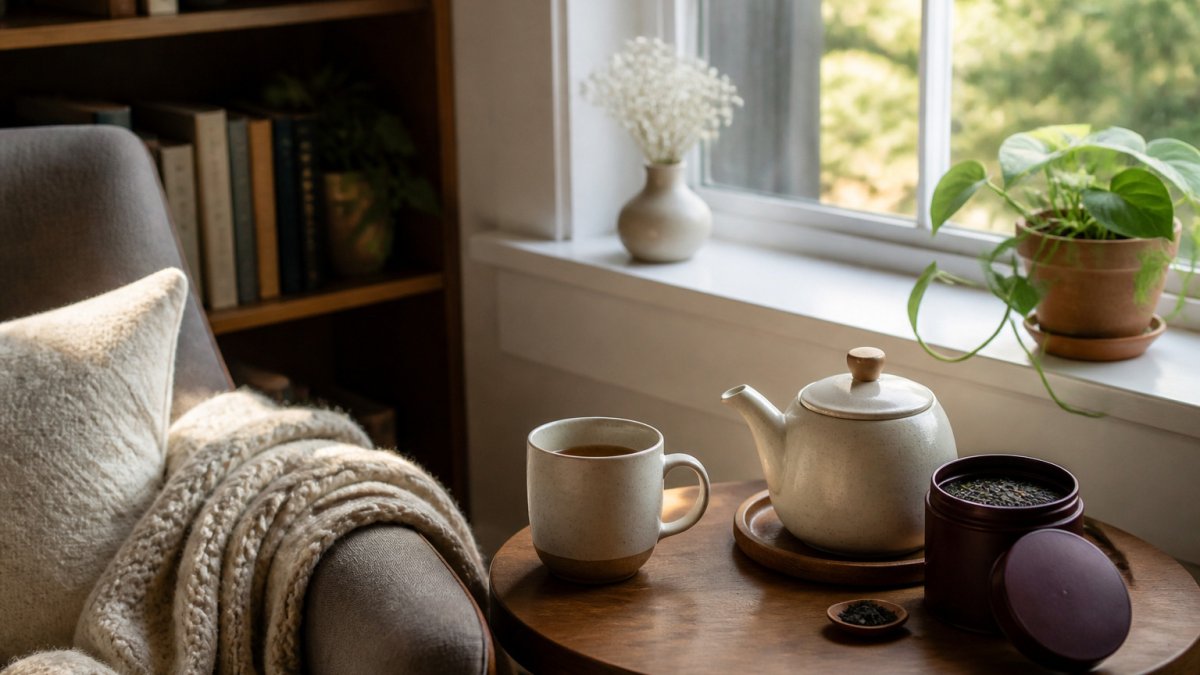
Pick one spot and use it every time. Over time, that spot itself becomes a signal to relax. A chair by a window, a corner of the kitchen table, or a spot on the couch can all work.
Gather what you will need before you start:
- A kettle or pot for heating water
- A favorite mug or teapot
- Your tea and an infuser or basket
- A small tray or coaster to keep things tidy
Keep the space free of work items. If your phone sits right next to you, put it on silent or in another room.
How to Make a Relaxing Cup of Tea, Step by Step
Brewing well is what separates a ritual you repeat from a cup you drink once and forget. Water temperature and steep time both affect the flavor of your cup. Too hot or too long and you pull out bitter, astringent notes; too cool or too short and the cup tastes thin and watery.
Different teas want different treatment. The ranges below are starting points, not rules, check the product page for the blend you bought, since leaf size and processing change the answer.
- Black tea: water at a full boil, about 200-212°F, steeped 3-5 minutes. Go shorter for smaller leaves.
- Green tea: cooler water, roughly 160-180°F, steeped 2-3 minutes. Boiling water on green tea is the most common reason it turns bitter.
- White tea: water around 175-185°F, steeped 3-5 minutes.
- Oolong: water around 185-200°F, steeped 3-5 minutes, and these leaves often reward a second steep.
A kitchen thermometer takes the guesswork out of temperature, but you can also boil water and let it rest a few minutes off the heat before pouring over green or white tea.
Here is the sequence for a single calming cup:
- Heat fresh water. Start with cold tap or filtered water rather than water that has been sitting in the kettle, and heat to the range for your tea.
- Measure the leaves. Add loose tea to your infuser or teapot. A common starting point is about one heaping teaspoon per cup, then adjust to taste, larger leaf pieces take more volume than fine ones.
- Pour slowly over the leaves so everything is fully submerged and can open evenly.
- Cover and steep for the time range for your tea. A small timer or your phone keeps you honest.
- Remove the leaves by lifting the infuser or straining into your mug. Leaving them in keeps extracting bitterness.
- Let it cool a moment before the first sip so the aroma reaches you before the heat does.
If you want a stronger cup, the better move is usually more leaf rather than more time, longer steeping pulls out the harsh notes first. Taste as you go, and treat every range above as a place to start rather than a target.
The table below summarises the steeping ranges and time for each tea type, as covered in the step-by-step section.
Tea type | Water temperature | Steep time |
|---|---|---|
Black tea | About 200-212°F | 3-5 minutes |
Green tea | Roughly 160-180°F | 2-3 minutes |
White tea | Around 175-185°F | 3-5 minutes |
Oolong | Around 185-200°F | 3-5 minutes |
Building an Evening Tea Ritual That Fits Your Schedule
A ritual only helps if it survives a bad week. The reason most tea rituals quietly stop is not that people lose interest, it is that the version they built was sized for their calmest day, so the first busy evening breaks the chain and the habit never restarts. The fix is to decide in advance what the ritual looks like at three lengths, so a packed day has a version that still counts.
Here is how the three versions work in practice:
- The two-minute version. Heat water, drop in a tea bag or pre-measured infuser, and stand at the counter while it steeps. No chair, no tray, no phone. This exists for the nights you are exhausted or running late. Its job is to keep the cue alive, not to be the good version.
- The ten-minute version. Kettle on, leaves measured, cup steeped, and you sit down for the steep plus a few minutes of quiet sipping. This is the everyday ritual for most people and the one worth protecting.
- The twenty-minute version. The full setup: the quiet spot, the tray, the phone in another room, and slow sipping with a few breaths between cups. Save this for the evenings you actually have the time, and do not make it the baseline you judge yourself against.
The mechanism behind all three is the same: a fixed cue, a short sequence of steps, and a reward at the end. Repeating the cue-step-reward loop is what turns the ritual from a decision into a default, and a two-minute version still fires the loop. Skipping a night does not erase it; abandoning the cue entirely does.
A few practical choices make the schedule fit easier:
- Anchor it to something you already do. After dinner, after the kitchen is closed, or after the last email, a ritual attached to an existing habit is far easier to keep than one attached to a clock time.
- Prep the night before. Set out the mug, the infuser, and the tin so the first step is already done when you walk in.
- Keep the gear where you can see it. Tea and mug on the counter beat tea and mug in a cabinet you have to open.
- Pick your time of day deliberately. An evening cup roughly 30-60 minutes before bed suits most people winding down; a morning or midday cup works for a short reset instead.
- Expect a few weeks before it feels automatic. A common pattern is that the ritual feels effortful for the first couple of weeks and then stops requiring thought.
One safety note worth building into the routine: if you take medication, are pregnant, or have allergies, check with a doctor before making a new herbal blend a daily habit, and read the ingredient list on the tin rather than assuming a floral blend is caffeine-free.
Practicing Mindful Tea Drinking
Mindful drinking means paying attention to the cup in front of you. You do not need special training to do it.
Use your senses as you sip. Notice the warmth in your hands, the aroma when you lift the cup, and the flavor as it settles on your tongue. Take slow breaths between sips.
Try this simple practice:
- Hold the cup with both hands for a few breaths before you drink
- Take one small sip and notice the first flavor you taste
- Set the cup down between sips instead of drinking on autopilot
Our Calming Chamomile tin is a good one to try this with, since its aroma is easy to notice.
Troubleshooting Your Tea Ritual and Keeping the Habit
Most problems with a tea ritual are simple to fix. If the tea tastes weak, steep it a little longer. If it tastes bitter, steep it for less time or use less tea.
If you keep skipping the ritual, shrink it. A two-minute version still counts, and it keeps the habit alive. Missing one day is not a failure. Just pick it up again the next evening.
Keep these ideas in mind:
- Keep your tea and mug where you can see them
- Repeat the same steps so the ritual feels familiar
- Expect a few weeks before the habit feels automatic
Start Your Own Tea Ritual with Octavia Tea
A calming tea ritual needs only a few things: a caffeine-free tea, a quiet spot, and a few minutes at the same time each day. Start with one cup tonight and see how it feels. Explore our full range of caffeine-free teas for relaxation at Octavia Tea and find a blend that fits your evenings.
Frequently Asked Questions
How do you create a calming tea ritual?
Pick one fixed time of day, choose a caffeine-free blend you enjoy, and set out the same mug, teapot, and infuser each time. Boil fresh water, steep the leaves for the time listed on the package, and sit down without a screen. Repeating these same steps at the same time builds the cue that signals your body to slow down. Start with five minutes if your schedule is tight and extend the ritual as it becomes routine.
What tea is best for a relaxing evening ritual?
Herbal blends made without caffeine are the usual choice for evenings. Chamomile is a common base; Octavia Tea's Calming Chamomile, priced at $3.50, is whole chamomile flowers, and Moonlight Garden, also $3.50, blends chamomile with lavender, spearmint, and rose. Check the ingredient list for caffeine-containing tea such as black or green tea, and keep in mind that individual reactions to any herb vary.
Can caffeine-free tea help you unwind?
Caffeine-free tea can support a wind-down routine, mainly because the ritual itself signals rest: warm water, a quiet setting, and slow sipping. Tea is not a treatment for insomnia or anxiety, so if sleep or stress problems persist, speak with a healthcare provider, especially if you take medication or are pregnant.
How long should a tea ritual take?
A tea ritual can take anywhere from five minutes to half an hour. A short version fits a busy workday: boil water, steep, and drink one cup without multitasking. A longer version works on weekends, with a second steep and time to notice the aroma and flavor. The best length is the one you can repeat most days.


Octavia Tea Sign In
Create New Account