


















India
India
About India
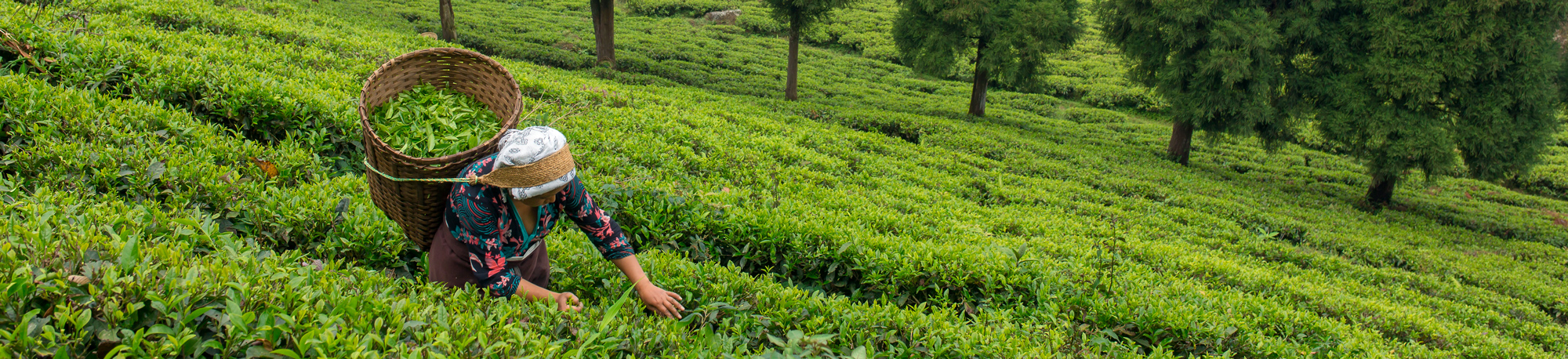
India is the 2nd largest producer of tea after China, and home to two of the world’s most famous growing regions: Assam and Darjeeling. Most tea produced in India is black tea. Tea grown in India tastes quite different than tea grown in China, due in part to terroir (climate, water, soil, elevation), and also because of a natural subdivision in the tea plant itself.
Although considered the same species as the Chinese tea plant, the tea plant native to India, the Camellia sinensis assamica, evolved to flourish in the hot tropical climate. The Indian tea plant has larger leaves better suited to soaking up extra sun and yields a more intense, brisk, bright, sometimes bitter flavor. Desperate for a new source for tea exports during the Opium wars, early British innovators did not immediately recognize that these two plants belonged to the same species and spent many years attempting to smuggle tea plants out of the secretive Chinese industry before discovering the assamica subspecies right under their nose. However, their stolen Chinese plants flourished in the foothills of Darjeeling, where the Chinese variety is still grown almost exclusively today.
Lower average temperatures and limited sunlight cause the tea plants to grow more slowly, developing more complex flavors and less bitterness. Fast growth of the plant powered by increased rainfall during annual monsoons, a hotter climate, and increased sunlight increase yields but result in a less complex, stronger, more bitter brew. Due to the natural characteristics of the Indian tea plant as well as the growing conditions in much of India, Indian teas (with the exception of Darjeeling) are often taken with milk as it balances the increased strength and bitterness without overpowering the tea’s flavor. 
Referred to as the Champagne of teas, Darjeeling is India’s most famous tea-producing region; The 87 tea gardens along the foothills of the majestic Himalayas produce some of the best teas in the world. Some of the tea bushes in Darjeeling are 150+ years old and grow at some of the highest elevations possible of any tea garden, between 4,000-6,000 meters above sea level. The resulting tea brews up a refined, complex character embodying a meadow’s worth of fruits and flowers, and stands in stark contrast to India’s brawny lowland teas. Darjeeling tea is so popular that each year, the amount of tea sold as Darleeing is roughly four times the maxium yield. To combat this fraudulant activity, Darjeeling is the first Indian product protected by the GI Act (Geographica Indication of Goods Registration and Protection Act), similar to protected designation-of-origin used by the EU for many European cheeses, or regional wines like Champagne or Bordeaux.
The Himalayan mountains and unique terroir mean that the highly sought-after flavor of Darjeeling tea cannot be replicated anywhere else. There are 4 major seasons of Darjeeling production: 1st flush, 2nd flush, Monsoon flush, and Autumn flush. The first two flushes of the year are highly prized and most sought after by tea buyers as the flavors are densely packed due to slow growth and influx of nutrients from the plants coming out of their winter hibernation. 1st flush Darjeelings are a celebration of the first tea harvest of the year, and weather-depending, begins in late March and lasts through the end of April. Teas produced during this period are often mistaken for green teas, with lighter, more floral nuances of nectarines, freshly cut flowers, muscat grapes, and the highly-prized vegetal/earthy/pine-tree-like astringency that makes Darjeeling teas so famous. The 2nd flush begins late may and lasts through June. Teas produced during this period have a richer, fruitier, full-bodied flavor than teas from the 1st flush, and are wonderfully complex with notes of nuts, flowers, and fruits with a balanced astringency and caramel finish.
Whereas there are only around 80 gardens that make up all of Darjeeling, the Assam region of India has over 800. While Assam is located only 120 miles from Darjeeling, the two regions produce vastly different flavors and styles of tea. Assam is known for its malty, bright, brisk, intense flavor. Assam tea, or blends containing Assam, are often sold as “breakfast” teas and produce that classic, full-bodied black tea. Assam teas come from the native Indian tea plant subspecies and are grown mostly at or around sea level in a tropical rainforest climate. Daytime temperatures near 100 F create greenhouse-like conditions of extreme tropical humidity and heat. The heavily forested region’s low elevation, hot climate, fertile soils, and generous rainfall cause the tea plant to grow quickly, making the state of Assam the world’s largest tea-growing region by production volume. The best Assam teas come from the 2nd flush picked during May or June, as the leaves are more “tippy” and contain a sweeter, more complex, full-bodied flavor.
Indian teas are classified by their region-of-origin (for example, Darjeeling, Assam, Nilgiri, and Sikkim), often season-of-origin (1st flush, 2nd flush, Monsoon, and Autumn Flush), and by a specialized grading system using a series of initials. The grading system does not necessarily indicate quality as it does not evaluate flavor, but instead simply reflects the size and appearance of the leaf. …often associated with higher quality teas. BOP (Broken Orange Pekoe) describes small tealeaves or pieces of larger tealeaves. SFTGFOP (Special Finest Tippy Golden Flowery Orange Pekoe) is the best classification. The tea can fall anywhere in-between (for example, GFOP, TGFOP, etc.). It is interesting to note, “Orange Pekoe” is not orange flavored tea; this designation simply describes a basic black tea consisting of many whole leaves of a specific size.
Loading...
Filter
Shopping Options
Sort By

India

India is the 2nd largest producer of tea after China, and home to two of the world’s most famous growing regions: Assam and Darjeeling. Most tea produced in India is black tea. Tea grown in India tastes quite different than tea grown in China, due in part (read more...)
+

India is the 2nd largest producer of tea after China, and home to two of the world’s most famous growing regions: Assam and Darjeeling. Most tea produced in India is black tea. Tea grown in India tastes quite different than tea grown in China, due in part to terroir (climate, water, soil, elevation), and also because of a natural subdivision in the tea plant itself.

Although considered the same species as the Chinese tea plant, the tea plant native to India, the Camellia sinensis assamica, evolved to flourish in the hot tropical climate. The Indian tea plant has larger leaves better suited to soaking up extra sun and yields a more intense, brisk, bright, sometimes bitter flavor. Desperate for a new source for tea exports during the Opium wars, early British innovators did not immediately recognize that these two plants belonged to the same species and spent many years attempting to smuggle tea plants out of the secretive Chinese industry before discovering the assamica subspecies right under their nose. However, their stolen Chinese plants flourished in the foothills of Darjeeling, where the Chinese variety is still grown almost exclusively today.

Lower average temperatures and limited sunlight cause the tea plants to grow more slowly, developing more complex flavors and less bitterness. Fast growth of the plant powered by increased rainfall during annual monsoons, a hotter climate, and increased sunlight increase yields but result in a less complex, stronger, more bitter brew. Due to the natural characteristics of the Indian tea plant as well as the growing conditions in much of India, Indian teas (with the exception of Darjeeling) are often taken with milk as it balances the increased strength and bitterness without overpowering the tea’s flavor. 

Referred to as the Champagne of teas, Darjeeling is India’s most famous tea-producing region; The 87 tea gardens along the foothills of the majestic Himalayas produce some of the best teas in the world. Some of the tea bushes in Darjeeling are 150+ years old and grow at some of the highest elevations possible of any tea garden, between 4,000-6,000 meters above sea level. The resulting tea brews up a refined, complex character embodying a meadow’s worth of fruits and flowers, and stands in stark contrast to India’s brawny lowland teas. Darjeeling tea is so popular that each year, the amount of tea sold as Darleeing is roughly four times the maxium yield. To combat this fraudulant activity, Darjeeling is the first Indian product protected by the GI Act (Geographica Indication of Goods Registration and Protection Act), similar to protected designation-of-origin used by the EU for many European cheeses, or regional wines like Champagne or Bordeaux.

The Himalayan mountains and unique terroir mean that the highly sought-after flavor of Darjeeling tea cannot be replicated anywhere else. There are 4 major seasons of Darjeeling production: 1st flush, 2nd flush, Monsoon flush, and Autumn flush. The first two flushes of the year are highly prized and most sought after by tea buyers as the flavors are densely packed due to slow growth and influx of nutrients from the plants coming out of their winter hibernation. 1st flush Darjeelings are a celebration of the first tea harvest of the year, and weather-depending, begins in late March and lasts through the end of April. Teas produced during this period are often mistaken for green teas, with lighter, more floral nuances of nectarines, freshly cut flowers, muscat grapes, and the highly-prized vegetal/earthy/pine-tree-like astringency that makes Darjeeling teas so famous. The 2nd flush begins late may and lasts through June. Teas produced during this period have a richer, fruitier, full-bodied flavor than teas from the 1st flush, and are wonderfully complex with notes of nuts, flowers, and fruits with a balanced astringency and caramel finish.

Whereas there are only around 80 gardens that make up all of Darjeeling, the Assam region of India has over 800. While Assam is located only 120 miles from Darjeeling, the two regions produce vastly different flavors and styles of tea. Assam is known for its malty, bright, brisk, intense flavor. Assam tea, or blends containing Assam, are often sold as “breakfast” teas and produce that classic, full-bodied black tea. Assam teas come from the native Indian tea plant subspecies and are grown mostly at or around sea level in a tropical rainforest climate. Daytime temperatures near 100 F create greenhouse-like conditions of extreme tropical humidity and heat. The heavily forested region’s low elevation, hot climate, fertile soils, and generous rainfall cause the tea plant to grow quickly, making the state of Assam the world’s largest tea-growing region by production volume. The best Assam teas come from the 2nd flush picked during May or June, as the leaves are more “tippy” and contain a sweeter, more complex, full-bodied flavor.

Indian teas are classified by their region-of-origin (for example, Darjeeling, Assam, Nilgiri, and Sikkim), often season-of-origin (1st flush, 2nd flush, Monsoon, and Autumn Flush), and by a specialized grading system using a series of initials. The grading system does not necessarily indicate quality as it does not evaluate flavor, but instead simply reflects the size and appearance of the leaf. …often associated with higher quality teas. BOP (Broken Orange Pekoe) describes small tealeaves or pieces of larger tealeaves. SFTGFOP (Special Finest Tippy Golden Flowery Orange Pekoe) is the best classification. The tea can fall anywhere in-between (for example, GFOP, TGFOP, etc.). It is interesting to note, “Orange Pekoe” is not orange flavored tea; this designation simply describes a basic black tea consisting of many whole leaves of a specific size.

(read less...)
per page

20 Items

Set Descending Direction
View Grid List
  1. Afternoon Darjeeling (tin)

    Afternoon Darjeeling (tin)

    Organic black tea

    $19.00
  2. Darjeeling 1st Flush (tin)

    Darjeeling 1st Flush (tin)

    Organic black tea
    $17.50
    Out of stock
  3. Darjeeling Reserve (tin)

    Out of stock
  4. Himalayan Green (tin)

    Himalayan Green (tin)

    Organic green tea

    $16.50
  5. Royal Golden Assam (tin)

  6. Afternoon Darjeeling (sample)

    Afternoon Darjeeling (sample)

    Organic black tea

    $4.50
  7. Darjeeling 1st Flush (sample)

    Out of stock
  8. Darjeeling Reserve (sample)

    Out of stock
  9. Himalayan Green (sample)

    Himalayan Green (sample)

    Organic green tea

    $3.50
  10. Royal Golden Assam (sample)

  11. Afternoon Darjeeling (bulk 1 lb)

    Afternoon Darjeeling (bulk 1 lb)

    Organic black tea

    $90.00
  12. Darjeeling 1st Flush (bulk 1 lb)

    Out of stock
  13. Darjeeling Reserve (bulk 1 lb)

    Out of stock
  14. Himalayan Green (bulk 1 lb)

    Himalayan Green (bulk 1 lb)

    Organic green tea

    $56.00
  15. Royal Golden Assam (bulk 1 lb)

  16. Afternoon Darjeeling (bulk 4 oz)

    Afternoon Darjeeling (bulk 4 oz)

    Organic black tea

    $30.50
  17. Darjeeling 1st Flush (bulk 4 oz)

    Out of stock
  18. Darjeeling Reserve (bulk 4 oz)

    Out of stock
  19. Himalayan Green (bulk 4 oz)

    Himalayan Green (bulk 4 oz)

    Organic green tea

    $22.00
  20. Royal Golden Assam (bulk 4 oz)

per page

20 Items

Set Descending Direction
View Grid List
Copyright © 2013-present Magento, Inc. All rights reserved.