























What Are the Health Benefits of Pure Essential Oils?

Last Updated: October 29, 2026
Quick Summary
Pure essential oils are concentrated volatile plant extracts, and their best-supported benefits are relaxation, mood, and sleep support. Research in these areas is moderate but often small and mixed, while claims about treating infections, pain, or disease remain unproven. Treat pure essential oils as comfort and ritual support alongside, never instead of, medical care.
- Inhalation works fastest because volatile compounds travel from the nose close to the limbic system.
- Dilute oils in a carrier like jojoba or sweet almond and patch test on the inner forearm first.
- Diffuse in short sessions, ventilate the room, and take breaks, especially in small spaces.
- Store bottles tightly capped in a cool, dark place and check the aroma before reuse.
- Never swallow essential oils unless a qualified professional has directed it.
Table of Contents
- What Makes an Essential Oil Pure, and Why It Matters
- Health Benefits of Pure Essential Oils Backed by Research
- Essential Oil Safety and Dilution: What to Know Before You Apply
- How to Use an Essential Oil Diffuser at Home
- Essential Oils in Tea: Flavor, Aroma, and What to Expect
- Common Essential Oils and How They Are Used
- Choosing a Tea Blended With Pure Essential Oils
- Frequently Asked Questions
What Makes an Essential Oil Pure, and Why It Matters
Pure essential oils are concentrated volatile plant extracts obtained through distillation or expression. The health benefits of pure essential oils depend entirely on what is in the bottle: a fragrance oil labeled "lavender" may contain no lavender at all, which matters for anyone inhaling, applying, or drinking a tea scented with it.
The Difference Between Essential Oil and Pure Oil
An essential oil is the volatile, aromatic fraction captured from a single plant species, while a "pure oil" is simply oil not cut with carriers, synthetics, or cheaper fractions. Many budget products sold as essential oils are blends of synthetic aroma compounds in a neutral base that smell convincing but lack the same plant chemistry.
Here is what separates the two in practice:
- Source: True essential oils come from a named botanical, often with the Latin species on the label.
- Purity: A pure oil lists one ingredient. Blends should say so plainly.
- Price sanity: Genuine oils are expensive to produce, so unusually cheap bottles are a warning sign.
- Testing: Reputable suppliers publish batch documentation on request.
If a supplier cannot tell you the species and the batch, treat the product as a fragrance, not a botanical extract.
Health Benefits of Pure Essential Oils Backed by Research
The strongest evidence for pure essential oils sits in relaxation, mood, and sleep support; claims about curing disease remain unproven. Aromatherapy research is active, but much of it involves small groups, short durations, and self-reported outcomes, so check the sample size before changing your routine.
Stress, Mood, and Sleep Support
A common mistake is expecting a diffuser to replace sleep hygiene. For a deeper look at caffeine-free options, read our guide to organic herbal tea blends for sleep. For a cup to match the ritual, explore our stress relief teas. What it can do is anchor a wind-down ritual, and rituals carry real psychological weight. National Center for Complementary and Integrative Health overview of aromatherapy is a sensible starting point for anyone weighing the evidence, and it is refreshingly clear about where the research stands.
What the Evidence Does Not Yet Prove
Treat essential oils as comfort and ritual support. If you are managing a health condition, they belong alongside treatment, never instead of it. U.S. Food and Drug Administration guidance on aromatherapy claims draws a firm line between cosmetic aromas and drug claims, and that line is worth knowing before you trust a label.
How to Read an Essential Oil Study Without Getting Fooled
Condition-specific claims deserve extra scrutiny. Relaxation and sleep quality have the most human data, while claims about infections, pain, and chronic disease rest largely on lab findings or very small trials. The honest use case is comfort, ritual, and atmosphere, and the honest claim is "may support" rather than "treats" or "cures."
Where the Evidence Is Strongest, and Where It Is Thinnest
Sorting the research by condition is more useful than a single verdict on "essential oils." The table below reflects the general shape of the published literature, not a guarantee for any product.
Area | Strength of human evidence | What the research generally suggests |
|---|---|---|
Relaxation and perceived stress | Moderate | Inhalation and massage with diluted oils are associated with self-reported calm in small trials |
Sleep quality | Moderate but mixed | Some trials report improved sleep quality with lavender inhalation; results vary by population and setting |
Mood and anxiety in specific settings | Preliminary | Small trials in clinical and dental settings show short-term effects; larger, longer studies are lacking |
Antimicrobial activity | Lab only | Demonstrated in culture; not established as a treatment for infections in people |
Pain and inflammation | Preliminary | Some topical and massage trials show modest effects; quality varies widely |
Chronic disease, cancer, immune function | Unsupported | No adequate human trials support treatment claims |
The Mechanism Behind the Calm: Why Inhalation Works
Inhalation works faster than topical application because volatile compounds travel directly from the nose to the olfactory bulb, close to the limbic system, the brain region involved in emotion and memory. That shortcut explains why a scent can shift how a room feels within seconds and why the same oil can evoke a strong memory. It also explains the limits: the effect is sensory and psychological, not drug-like action on a disease process.
A Note on Aromatherapy and Massage
Massage with diluted essential oils is one of the better-studied applications, partly because the massage itself contributes to relaxation, and trials often cannot separate the oil's effect from the touch and ritual around it. A diluted massage oil in a calm setting is a reasonable comfort measure, not a treatment for a medical condition.
Essential Oil Safety and Dilution: What to Know Before You Apply
Essential oil safety and dilution come down to three variables: the oil, the route, and the person. Neat application is where most irritation happens. Skin reactions to undiluted oils are common enough that dilution should be your default, not a cautious extra step. Properly balancing these concentrations is essential for anyone incorporating essential oils for skin into their daily wellness routine, as understanding the physiological interaction between botanical compounds and the dermal barrier remains a critical component of safe topical use.
Why Dilution Matters: The Mechanism
Blend essential oils into a carrier such as jojoba, sweet almond, or fractionated coconut before applying to skin. A common starting point for adults is a low single-digit percentage of essential oil in the carrier, which translates to a small number of drops per ounce; more concentrated is not more effective and is more likely to irritate. Patch test on the inner forearm and wait a day before broader use.
Safe Use by Route
- Inhalation: Diffusing or inhaling from a bottle is the lowest-risk route for most adults. Run diffusers in short sessions, ventilate the room, and take breaks. People with asthma or other respiratory conditions should be cautious, since strong scents can trigger symptoms.
- Topical: Always dilute, always patch test, and keep oils away from the eyes, mucous membranes, and broken skin.
- Ingestion: Do not treat ingestion as routine self-care. Essential oils are not formulated for eating, can irritate the digestive tract, and some are toxic if swallowed. Any internal use belongs under the direction of a qualified professional.
Who Needs Extra Caution
- Pregnancy and breastfeeding: Some oils are best avoided during pregnancy, and the list varies by source. Ask a clinician before regular use.
- Children: Children are more sensitive to concentrated oils, and some oils should not be used around infants and young children at all. Keep bottles out of reach and never apply undiluted oils to a child's skin.
- Asthma and respiratory conditions: Strong scents can trigger symptoms. Test in a well-ventilated space and stop if breathing feels affected.
- Pets: Some oils are toxic to cats, dogs, and birds, and diffusers can concentrate scent in small rooms. Check with a veterinarian first.
- Medications and health conditions: Essential oils can interact with medications. A pharmacist or clinician can help you weigh the risks.
When to Seek Medical Care
Essential oils are not a substitute for diagnosis or evidence-based treatment. Seek medical care for a severe skin reaction, difficulty breathing, or swelling after exposure, and do not use essential oils to self-treat an infection, a persistent symptom, or a worsening condition. If a symptom lasts or concerns you, the right move is a clinician, not a stronger dilution.
Storage and Shelf Life
Essential oils degrade over time, and heat and light speed that process. Store bottles tightly capped in a cool, dark place, and check the aroma before using an old bottle, a flat or sour smell means the oil has changed. Keep bottles labeled and out of reach of children and pets, and never transfer oils into unmarked containers.
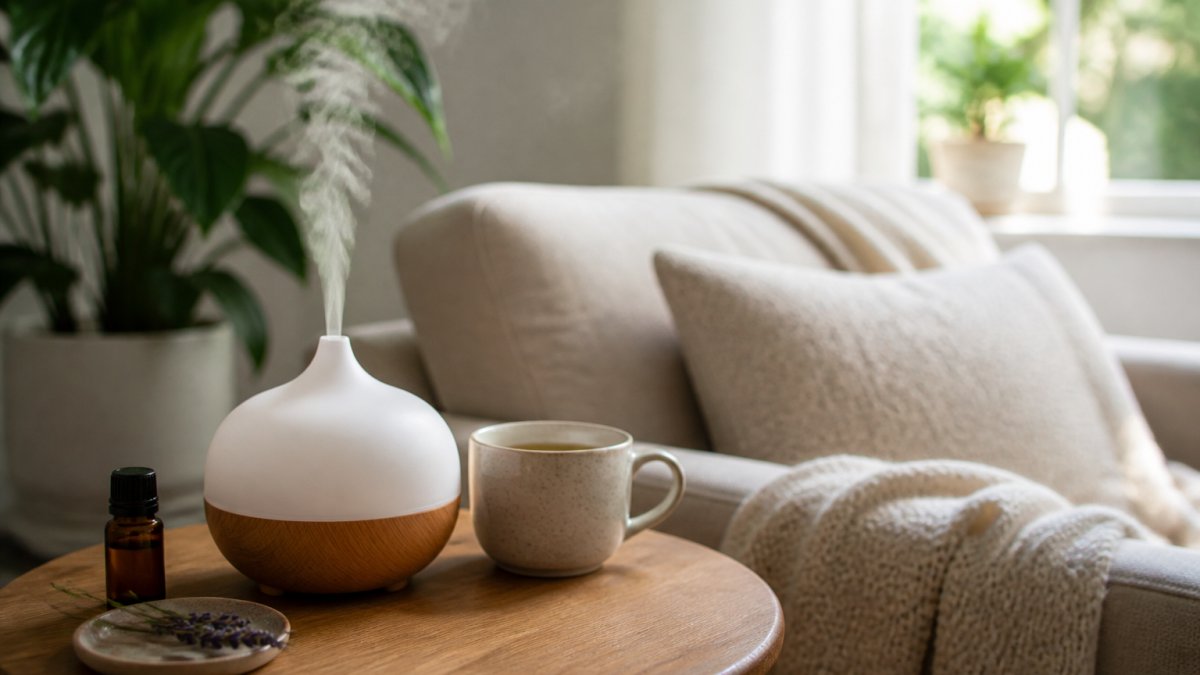
How to Use an Essential Oil Diffuser at Home
Running a diffuser well is mostly about restraint and airflow. Here is the routine we would follow in our own homes:
- Fill the reservoir to the marked line with cool water.
- Add a small number of drops, starting low and adjusting to room size.
- Place the unit on a stable surface, away from walls and electronics.
- Run it in short sessions rather than all day.
- Empty and dry the reservoir between uses to prevent residue buildup.
- Ventilate the room and take breaks, especially in small spaces.
Essential Oils in Tea: Flavor, Aroma, and What to Expect
Essential oils in tea function as flavor and aroma. This is why we hand-blend with natural flavor essences and pure essential oils without artificial ingredients.
Common Essential Oils and How They Are Used
If you want to explore these aromas in a cup rather than a bottle, our sampler set of mood-benefit teas is a straightforward way to taste the difference.
Choosing a Tea Blended With Pure Essential Oils
Choosing a tea blended with pure essential oils starts with the ingredient list: a named botanical, a clear statement of what the flavoring is, and a supplier willing to answer sourcing questions. Vague language like "natural flavors" tells you almost nothing, and you are allowed to ask for more.
Our tea blends are organic loose leaf teas hand-blended with natural flavor essences and pure essential oils, with no artificial ingredients.
Frequently Asked Questions
How can you tell whether an essential oil is pure?
Look for a full ingredient list that names the plant and nothing else, plus a stated botanical name and origin. Reputable sellers publish third-party test results or certificates you can request. Be cautious with labels that say fragrance oil, perfume oil, or natural identical, since those are not pure essential oils. If a company will not confirm how a product was tested, treat the purity claim as marketing rather than fact.
Are pure essential oils safe to use?
They are safe for most adults when used as directed, but pure does not mean risk-free. Essential oils are concentrated plant extracts, so skin contact usually calls for dilution in a carrier oil, and some oils cause irritation or reactions in sunlight. People who are pregnant, nursing, giving oils to children, or managing a health condition should check with a healthcare provider first. Keep bottles out of reach of pets and children.
Can essential oils be added to tea?
Some teas are blended with pure essential oils for aroma and flavor, which is different from adding drops from a bottle to your cup. Drinking undiluted essential oil is not recommended, since the concentration is far higher than what you get from a finished tea blend. If you want the flavor without the guesswork, choose a tea that lists essential oils in its ingredients and follow the steeping directions on the package.
What is the difference between essential oil and pure oil?
An essential oil is the concentrated aromatic compound extracted from a plant through distillation or pressing. Pure oil simply means nothing else has been added, so a pure essential oil is one that contains only that plant's extract. The terms overlap, but pure is a quality claim about the contents, while essential describes how the oil was made. A bottle can be labeled essential oil and still contain additives, which is why the ingredient list matters more than the front label.
The gap between a tea that smells lovely and one that tastes complete is usually a sourcing decision, and it is one you can verify. Octavia Tea hand-blends over 120 organic loose leaf teas using natural flavor essences and pure essential oils, with no artificial ingredients and USDA certified organic sourcing. Get started with Octavia Tea and taste what a properly built blend does for your daily ritual.


Octavia Tea Sign In
Create New Account