























7 Labeling Requirements for Homemade Tea Products

Last Updated: November 2, 2026
Quick Summary
Homemade tea sold in the United States must carry the same federal label information as any packaged food. The labeling requirements include a true product name, net weight in both U.S. customary and metric units, the business name and address, and a descending-weight ingredient list with allergens declared.
- Homemade tea is not exempt; federal FDA rules apply to small-batch and home-kitchen sellers.
- Net weight must appear in both U.S. customary and metric units.
- Ingredients are listed in descending order by weight, heaviest first.
- Major food allergens must be declared, either in the ingredient list or in a separate Contains statement.
- State cottage food laws vary, so confirm your state's position with its agency in writing.
Table of Contents
- What Labeling Requirements Apply to Homemade Tea
- Mandatory Label Information: Name, Net Weight and Business Address
- How to Write a Tea Ingredient List
- Allergen Labeling Requirements for Tea
- Nutrition Labeling Exemptions and Structure-Function Claims
- Cottage Food Laws for Tea: How State Rules Differ
- Booking Your Compliance Review Before You Sell
- Frequently Asked Questions
What Labeling Requirements Apply to Homemade Tea
If you sell homemade tea blends in the United States, the Food and Drug Administration (FDA) treats your product as a packaged food, which means it must carry specific label information before it reaches a customer. Those rules apply whether you sell at a farmers market, through an online shop, or to a café that resells your blend. Octavia Tea works within these same federal expectations, and we think every seller should understand them before the first pouch leaves the kitchen. You can see how a business sells and labels its loose-leaf products on the Himalayan Moon Drops oolong listing.
The federal baseline comes from the FDA food labeling guide. It sets out what every packaged food label must show, and it applies to dry loose-leaf tea just as it applies to a jar of jam. Brewed or ready-to-drink tea follows a different set of rules, so keep the two categories separate in your planning.
Homemade does not mean exempt. A common mistake is assuming that small-batch production or a home kitchen removes the obligation. It does not. The FDA's requirements follow the product, not the size of the business. Your state may add its own rules on top of the federal baseline.
Mandatory Label Information: Name, Net Weight and Business Address
Every packaged tea label needs three core elements: a product name that identifies what is inside, the net quantity of contents, and the name and place of business of the manufacturer, packer or distributor. Missing any one of these is the most common reason a homemade label gets flagged.
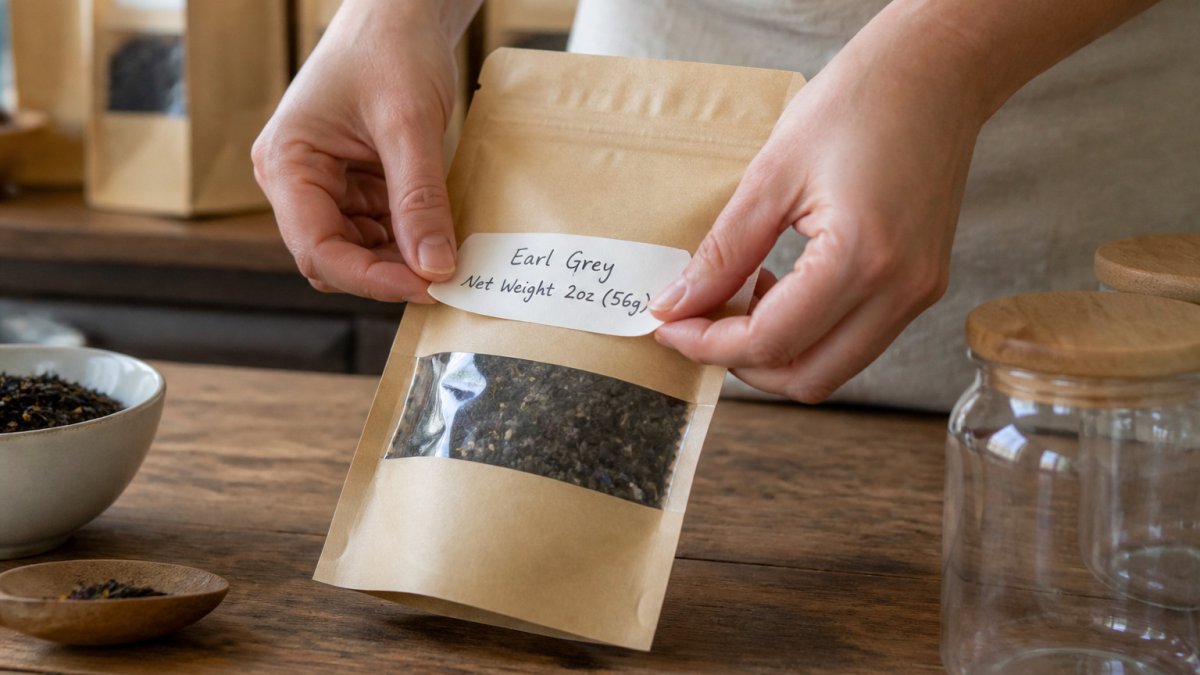
The product name must be a true statement of identity. "Lavender Earl Grey" works if it describes the blend accurately. A name that suggests an ingredient not present in the pouch is a problem.
Net weight must be stated in both U.S. customary units and metric units.
The business address must include the city, state and ZIP code.
The three core label elements and what each one requires:
| Element | What it must show | Note |
|---|---|---|
| Product name | A true statement of identity | Must match what is inside the pouch |
| Net weight | Both U.S. customary and metric units | Required on packaged foods |
| Business address | City, state and ZIP code | Manufacturer, packer or distributor name and place |
How to Write a Tea Ingredient List
Ingredients must be listed in descending order by weight, with the heaviest ingredient first (the FDA). For a blend of black tea, dried orange peel and natural flavor, the black tea leads because it makes up the largest share of the pouch. To compare against a commercially sold oolong, see the Ali Shan High Mountain tin listing.
Use the common or usual name of each ingredient. For a concrete example of how a single-ingredient tea is described, look at the Pumpkin Spice Chai sample listing. "Black tea" is clearer than a botanical name, and "natural flavor" is acceptable as a category when the flavor is derived from a natural source. Avoid vague terms such as "spices" when you can name them.
Sub-ingredients in a compound ingredient may need to be declared. If you add a pre-made flavor blend, the FDA may require you to list its components. Ask your supplier for a full ingredient breakdown so your list is accurate.
A practical habit: write the ingredient list from the recipe card you actually use, then check it against the supplier certificates for each component. Mismatches between the label and the recipe are a frequent source of compliance trouble.
Allergen Labeling Requirements for Tea
Under the Food Allergen Labeling and Consumer Protection Act, major food allergens present in a food must be declared (the FDA). Flavored blends sometimes contain them, such as a chai with milk powder or a blend with almond pieces, and those must be declared.
Declare allergens either within the ingredient list, with the allergen named in parentheses or in bold, or in a separate "Contains" statement directly after the list. Either approach works as long as the allergen is easy to spot.
Cross-contact is a separate issue. If your blends are made on shared equipment with allergenic ingredients, consider a precautionary statement. It is voluntary but helpful for customers with sensitivities. Clear allergen disclosures matter across artisan tea blends, where knowing how ingredients are combined can help customers choose with confidence.
Nutrition Labeling Exemptions and Structure-Function Claims
Two separate questions apply here: whether a pouch needs a Nutrition Facts panel, and what claims may be made about the tea's effect on the body. They are governed by different rules.
When a homemade tea label can skip the Nutrition Facts panel
A practical sequence for a home producer: list every ingredient and estimate whether any adds meaningful calories, fat, sodium, carbohydrate, or protein per serving; if none do, document that reasoning and check the insignificant-amount criteria; if any do, either file the small business notice (if you qualify) or prepare a full Nutrition Facts panel using the FDA's labeling guidance and a nutrient database for your recipe. Keep the filing confirmation and your nutrient worksheet with your label records.
What you can and cannot say about health benefits
A workable habit is to keep a claim file. For background on how brewing conditions affect what a tea delivers, see steeping temperature and nutrient retention. For every structure-function statement on your label or website, write down the ingredient it refers to, the general accepted role of that ingredient in normal function, and the disclaimer text you used. If a state inspector or an online marketplace reviewer asks, you have an answer ready rather than a scramble.
Cottage Food Laws for Tea: How State Rules Differ
Federal labeling rules set a baseline, but state cottage food laws also determine whether a home kitchen can produce tea for sale, and they vary from state to state. The variables that matter are consistent even though the answers are not, so the useful approach is to learn the four or five levers every state pulls and then look up where your state sits on each.
The levers that decide whether your tea qualifies
Whether a dry tea blend qualifies can differ by state, so check your own state's statute and the department that administers it.
How to confirm your state's position without guessing
Start with your state agency's cottage food guidance rather than a blog summary. If tea is not clearly named, ask the agency in writing whether a dried loose-leaf tea blend made in a home kitchen is covered.
Build any required state disclosure into the label design from the start. Keep a dated copy of the state rule you relied on with your label file, so you can show what you followed if rules change.
Booking Your Compliance Review Before You Sell
Labeling rules are easier to get right before you print a single pouch. Consider a compliance review with a food regulatory professional or your state's food safety program before you sell.
If you are a retailer, café or boutique considering a supplier, ask whether their labels meet these requirements. Contact our team to ask about wholesale terms.
Frequently Asked Questions
What are the FDA labeling requirements for tea?
Packaged tea sold in the United States generally needs a statement of identity, a net quantity of contents, an ingredient list, and the name and address of the manufacturer, packer or distributor. Packaging must also carry any required allergen declaration. Requirements can vary with product type, so review the FDA's food labeling guidance and confirm the details that apply to your specific blend before printing labels.
Do cottage food laws allow the sale of homemade tea?
Cottage food laws are set by each state, and they differ widely. Some states allow sales of certain non-potentially-hazardous foods made in a home kitchen, while others limit sales to direct-to-consumer channels or prohibit them for certain products. Because tea blends may be treated differently from baked goods, check your state's cottage food rules and your local health department before selling.
What information must be included on a tea ingredient label?
A tea ingredient label should list every ingredient in descending order by weight, using common names. Blends that include flavorings, botanicals or essential oils should name them clearly rather than using vague terms. Accurate ingredient listing supports both consumer trust and compliance, and it helps buyers identify allergens and additives they want to avoid.
How do I properly declare allergens on tea packaging?
Major food allergens must be declared on the label, either within the ingredient list or in a separate Contains statement. In the United States, the major allergens include milk, eggs, fish, shellfish, tree nuts, peanuts, wheat, soybeans and sesame. Review every ingredient in a blend, including flavorings and carriers, and declare any allergen source clearly so buyers can make informed choices.


Octavia Tea Sign In
Create New Account