























7 Ways Organic Tea Farming Protects the Environment

Last Updated: November 9, 2026
Quick Summary
Organic tea farming protects the environment mainly by avoiding synthetic pesticides and fertilizers, which reduces nutrient runoff and water contamination. It also builds soil organic matter through compost, cover crops and mulch, and keeps hedgerows and shade trees that support biodiversity. The net carbon benefit depends on yield, processing and transport.
- Synthetic nitrogen fertilizer is usually the largest emissions source on conventional tea estates.
- Organic estates use compost, cover crops and mulch to feed soil rather than soluble nitrogen.
- Hedgerows, shade trees and uncultivated margins give insects, birds and soil organisms habitat.
- Soil carbon gains are slow and reversible, so treat them as a gradual benefit rather than a permanent offset.
- Drying energy, packaging and transport are not captured by an organic seal and can offset farm-gate gains.
Table of Contents
- What Organic Tea Farming Means for the Environment
- How Synthetic Inputs Affect Soil and Water in Conventional Tea
- Soil Health, Organic Matter and Microbial Life on Organic Estates
- Organic Tea and Biodiversity: What Changes on the Ground
- Carbon Footprint of Organic Versus Conventional Tea
- Sustainable Tea Production Beyond the Organic Label
- Choosing Organic Tea With Environmental Impact in Mind
- Frequently Asked Questions
What Organic Tea Farming Means for the Environment
Organic tea farming is a production system that rules out synthetic pesticides and fertilizers and relies on soil biology, hedgerows and shade trees to keep plants healthy. The environmental case for organic farming starts with what farmers leave out of the field as much as what they put in. Certification in the United States is handled through the USDA National Organic Program, which sets the rules that a farm must follow to sell certified organic products.
Most of the environmental benefits come from changes in how the soil and surrounding land are managed. Organic estates rely on compost, cover crops and mulch to feed the soil, rather than soluble nitrogen. Sample a sustainably sourced option in our organic matcha powder. That shift affects water, soil life and the wider ecosystem around each garden.
How Synthetic Inputs Affect Soil and Water in Conventional Tea
Conventional tea estates often apply synthetic nitrogen fertilizer on a regular schedule to push yields. Soluble nitrogen that the plants do not take up can move with rainwater and irrigation, which is why it is a recognized source of nutrient runoff into streams and groundwater (the EPA). Repeated use of ammonium-based fertilizers can also lower soil pH over time, a process called soil acidification.
Pesticide use raises a separate concern. Residues and spray drift can reach waterways and affect the aquatic life that depends on them. Organic estates avoid these inputs, which reduces the chance of that contamination reaching local water sources. The exact impact depends on the estate, the climate and the chemicals used, so the difference is best judged farm by farm.
Soil Health, Organic Matter and Microbial Life on Organic Estates
Soil organic matter is the foundation of soil health. Compost, leaf litter and cover crops add carbon to the soil, which helps it hold water and resist erosion during heavy rain. Organic management tends to build this organic matter gradually, and healthier soil supports a more active community of fungi and bacteria. For the health side of the choice, read our guide to the best organic tea for heart health.
Those soil organisms help cycle nutrients, so plants can access them more gradually and with less loss. A soil with stronger microbial activity is generally more resilient to drought and heavy rainfall, though results vary by site and season. Many organic growers track these changes over several years rather than expecting quick results.
Organic Tea and Biodiversity: What Changes on the Ground
Tea pickers working among rows of bushes on an organic estate, with hedgerows and shade trees visible behind them.
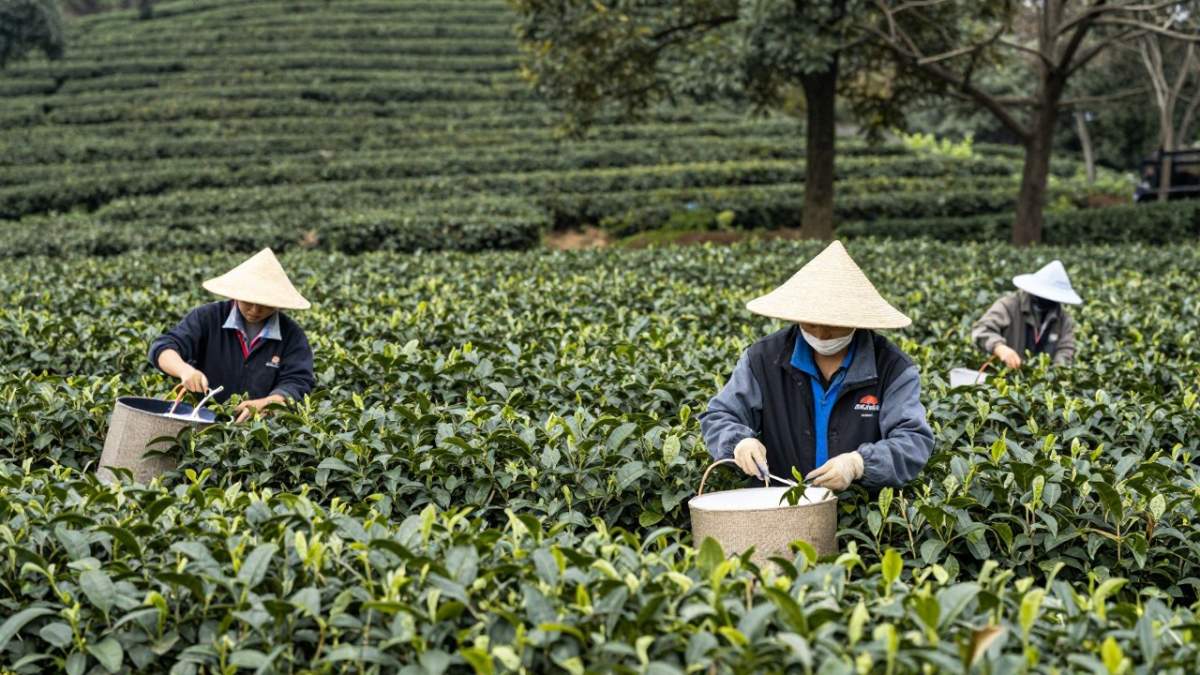
Biodiversity on a tea estate depends heavily on how the land is managed. Organic estates typically keep hedgerows, shade trees and uncultivated margins, which give insects, birds and soil organisms places to live. Removing synthetic pesticides also protects pollinators and beneficial insects that would otherwise be harmed by spray programs.
Monoculture, meaning large areas planted with a single crop, reduces habitat variety. Organic systems often include mixed planting and natural buffers, which create more diverse habitat. The gains are real but gradual, and they depend on how much land an estate keeps in natural cover.
Carbon Footprint of Organic Versus Conventional Tea
Greenhouse gas emissions from tea come from several stages, and understanding which stage dominates is what separates a useful comparison from a vague one. The main sources are fertilizer manufacture, field operations, processing and drying, packaging, and transport. On conventional estates, synthetic nitrogen fertilizer is usually the single largest contributor, for two reasons: producing it is energy intensive, and once applied to the soil it can be converted by microbes into nitrous oxide, a greenhouse gas with far more warming potential per molecule than carbon dioxide. Organic systems avoid synthetic nitrogen, but they are not automatically low-carbon, because compost production, organic amendments, and lower yields per acre can offset some of the savings.
A lifecycle assessment, or LCA, is the tool that makes the comparison honest. An LCA accounts for emissions from cradle to grave: raw material extraction, fertilizer and amendment production, field emissions, processing energy, packaging, and distribution. Two choices inside an LCA change the answer dramatically. The first is the functional unit, whether you compare per kilogram of made tea or per hectare of land. Per-hectare comparisons tend to favor organic because organic systems often store more carbon in soil organic matter; per-kilogram comparisons can favor conventional because higher yields spread the same field emissions across more product. The second is system boundary, whether the assessment stops at the farm gate or includes drying, shipping, and packaging. Most practitioners find that on-farm differences shrink once post-farm stages are included, because drying and transport are similar for both systems.
Soil carbon is the piece most often overstated. Organic management does tend to build soil organic matter through compost, mulch, and cover crops, and that stored carbon counts as a real removal in an LCA. But the rate of accumulation slows over time, and it can be reversed if the estate later returns to conventional tillage or loses its organic matter to erosion. Treat soil carbon as a slow, reversible gain rather than a permanent offset. Because soil carbon is a slow, reversible gain rather than a permanent offset, it is worth weighing that environmental benefit alongside the everyday choice of drinking organic tea from ASE'.
Watch out: a brand that quotes a single carbon number for its tea without stating the functional unit, the system boundary, and whether offsets are included is giving you a marketing figure, not a measurement. Ask which stages are covered before you compare two products.
The practical takeaway is that organic tea usually wins on fertilizer-related emissions and soil carbon, while the overall footprint depends on yield, processing energy, and how far the tea travels. Reliable, tea-specific LCA figures are still limited, so the most defensible claim is directional: organic management removes the synthetic-nitrogen emissions pathway and tends to build soil carbon, and the size of the net benefit varies by estate.
The article breaks down where tea emissions come from and how the comparison depends on the method used.
| Emission source | Why it matters | Note |
|---|---|---|
| Synthetic nitrogen fertilizer | Energy-intensive to produce; converted to nitrous oxide in soil | Usually the largest contributor on conventional estates |
| Field operations | Contribute to the farm's footprint | Compared per hectare or per kilogram |
| Processing and drying | Energy use varies by fuel | Similar for both systems |
| Packaging | Adds material emissions | Not captured by organic seals |
| Transport | Distance and mode add emissions | Can offset farm-gate gains |
| Soil organic matter | Stores carbon in organic systems | Slow, reversible gain |
Sustainable Tea Production Beyond the Organic Label
An organic certificate addresses inputs, what a farm may and may not apply, but it does not cover everything that shapes a tea's total footprint. Water management, energy use in drying and processing, packaging, and labor conditions all sit outside the organic standard, which is why some estates pursue additional practices on top of certification. Agroecology is the umbrella term for that approach: it treats the farm as an ecosystem and manages crop production together with the surrounding landscape rather than in isolation. On a tea estate, agroecology shows up as shade-tree canopies that moderate temperature and support beneficial insects, hedgerows and flower margins that host pollinators, cover crops between rows that protect soil between flushes, and rainwater harvesting or small-scale renewable energy for processing.
Regenerative agriculture takes the next step by aiming to rebuild soil and ecosystems over time rather than merely avoid harm. The core techniques are cover cropping, reduced tillage, compost and mulch application, and keeping living roots in the soil year-round. Each one works through a specific mechanism: cover crops and mulch feed soil microbes and protect the surface from erosion, reduced tillage limits the disturbance that releases stored carbon, and continuous plant cover keeps the soil food web active between harvests. For tea, which is a perennial crop, the leverage is different from annual farming, the bushes stay in place for decades, so the management that matters most is what happens in the inter-row space and how prunings and litter are handled. Estates that return prunings to the soil and maintain ground cover between rows tend to build organic matter faster than those that clear and burn. See how a carefully managed, volcanic-soil garden looks in our Sencha Kagoshima.
Post-harvest stages are where the label says the least. Drying and firing are energy-intensive, and an estate powered by firewood or diesel has a very different footprint from one using grid electricity or renewables. Packaging choices, loose leaf in minimal material versus individually wrapped bags, and the distance a tea travels to reach you both add emissions that no organic seal captures. A common pattern is for the farm-gate gains of organic management to be partly offset by long-distance air freight, so origin and shipping method matter as much as the certificate.
Social sustainability belongs in the same conversation. Organic conversion changes how workers handle the land, fewer pesticide applications means less occupational exposure, but it does not by itself guarantee fair wages or safe conditions. Some estates pair organic certification with third-party social auditing, and asking about labor practices is a fair question alongside questions about soil and water.
Octavia Tea sources from estate gardens, and the label alone does not show how a particular garden operates. When you evaluate a tea, treat organic certification as the floor and ask what the estate does beyond it: how it manages inter-row ground cover, how it dries and powers its processing, how it packages, and how it treats the people who pick.
Choosing Organic Tea With Environmental Impact in Mind
When you shop for organic tea, look for a USDA organic seal, and then ask about the garden itself. Useful questions include how the estate manages soil, whether it keeps hedgerows and shade trees, and how it handles water and energy.
Our selection of over 120 organic loose leaf teas is sourced from estate gardens. Browse the collection to find teas that fit your priorities. For current pricing, check our website.
Frequently Asked Questions
What are the environmental impacts of tea production?
Conventional tea production can affect soil, water and air. Heavy use of synthetic fertilizers can lead to soil acidification and nutrient leaching into waterways, while pesticide runoff can reach nearby streams. Clearing land for plantations can contribute to deforestation and biodiversity loss, and fertilizer use adds to greenhouse gas emissions. Organic practices aim to reduce these pressures, though their net effect depends on yield, management and location.
Does organic tea have a lower carbon footprint than conventional tea?
Organic systems generally avoid synthetic nitrogen fertilizers, whose production and application release greenhouse gases, so they often have a lower carbon footprint per unit of area. However, organic yields can be lower, which can offset that advantage per kilogram of tea. Lifecycle assessments of specific farms give the clearest answer, and processing and transport also contribute to total emissions.
How does organic tea farming affect soil health?
Organic tea estates typically rely on compost, mulch and cover crops to build soil organic matter, which improves water holding capacity and supports microbial diversity. Avoiding synthetic inputs can reduce soil acidification over time. Results vary with soil type, rainfall and how well the estate manages erosion on slopes.


Octavia Tea Sign In
Create New Account