























Sourcing High Quality Wholesale Herbal Teas: A 2026 Guide

Table of Contents
- What Makes Wholesale Herbal Teas Worth the Investment
- Evaluating Organic Loose Leaf Tea Wholesale Suppliers
- Understanding Bulk Herbal Tea Storage Best Practices
- Tea Sourcing Sustainability Certifications That Matter
- Calculating Profitability and Cost Per Cup
- Quality Assurance and Testing Standards
- Navigating Minimum Order Quantities and Logistics
- Conclusion
- Frequently Asked Questions
Last Updated: August 28, 2026
What Makes Wholesale Herbal Teas Worth the Investment
Sourcing high quality wholesale herbal teas requires more than finding the cheapest supplier. The difference between a mediocre wholesale herbal teas program and one that drives real revenue comes down to three factors: quality verification, supply chain transparency, and understanding what your customers actually value.
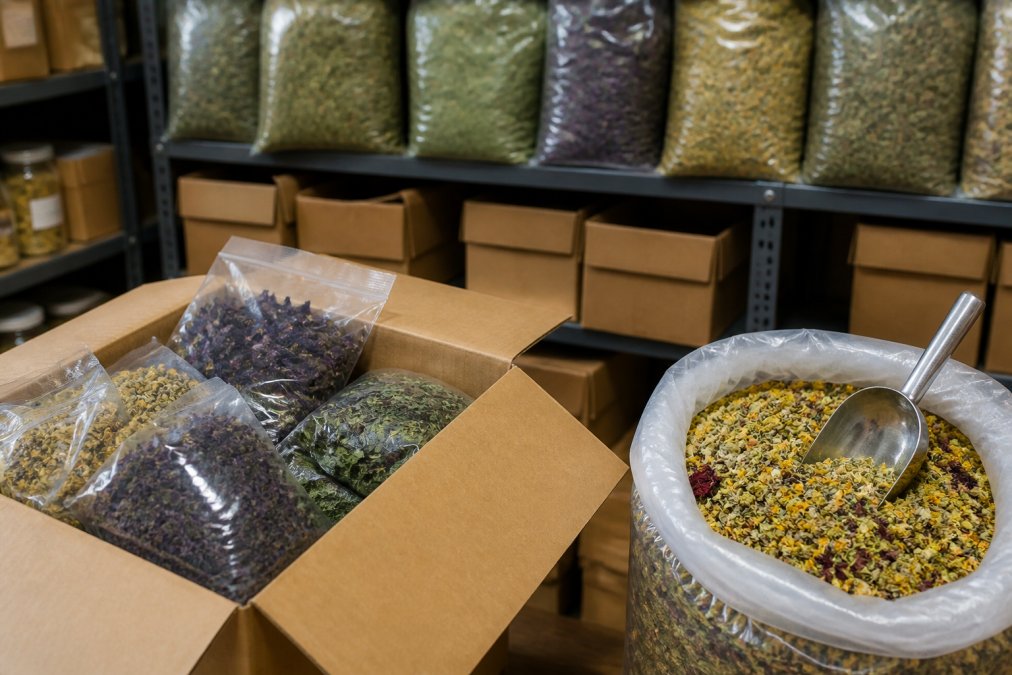
When you stock loose leaf tea instead of tea bags, you're making a statement about your business. Your customers notice. They taste the difference. But that premium positioning only works if the product behind it is legitimate.
At Octavia Tea, we've worked with retailers, cafes, and spas across the country who initially hesitated on loose leaf. Their concern was always the same: the cost-per-cup seemed high compared to conventional tea bags. Then they ran the numbers properly. A single serving of quality loose leaf tea costs less than most customers expect, and the ritual of brewing it commands a price point that justifies the wholesale investment (peer-reviewed research).
The real question isn't whether wholesale herbal teas are worth it. It's whether you're sourcing from suppliers who actually understand quality. Many wholesalers move volume. The best ones move integrity.
Evaluating Organic Loose Leaf Tea Wholesale Suppliers
Finding a reliable supplier for wholesale herbal teas starts with verification. You need to see the certifications, understand the sourcing story, and confirm that what's on the label matches what's in the bag.
Verifying Third-Party Certifications
Third-party certifications aren't marketing fluff, they're your legal and quality protection. When a supplier claims their loose leaf tea is organic, ask for proof. The USDA Organic certification is the baseline standard in the market. It means the tea was grown without synthetic pesticides, herbicides, or fertilizers, and the supply chain was audited to verify that claim (usda.gov).
Beyond USDA Organic, look for certifications that signal additional commitments. Some suppliers pursue Fair Trade certification, which verifies that farmers received fair compensation and worked in safe conditions. Others pursue certifications from organizations that specialize in botanical testing and contamination screening.
The key is asking for a Certificate of Analysis (COA) from an independent lab. This document shows exactly what's in the tea: moisture content, microbial testing results, and screening for heavy metals or pesticide residues. Legitimate suppliers have these on file and share them without hesitation. If a potential wholesale herbal teas vendor can't produce one, that's a red flag.
Assessing Supply Chain Transparency
Supply chain transparency separates trustworthy suppliers from ones cutting corners. When you source wholesale herbal teas, you need to know where each botanical actually came from. A quality supplier can tell you which estate or region produced each component, when it was harvested, and how it was processed.
Ask your potential supplier these specific questions: Where are your botanicals sourced? Do you work directly with farmers or through intermediaries? How do you verify that what you receive matches what you ordered? Can you trace a specific batch back to its origin?
The suppliers worth working with embrace this scrutiny. They understand that their wholesale herbal teas are only as good as their sourcing practices. Direct relationships with growers reduce the risk of adulteration or contamination. When a supplier can show you their sourcing map, they're demonstrating confidence in their supply chain.
Understanding Bulk Herbal Tea Storage Best Practices
Once you've sourced your wholesale herbal teas, storage becomes critical. Loose leaf tea is more vulnerable to degradation than tea bags because of its higher surface area exposure to air and light. Improper storage will degrade quality faster than almost anything else.
The enemy of tea freshness is oxidation, moisture, and light. Store your bulk herbal tea in airtight containers, glass jars with tight seals or metal tins work well. Avoid plastic, which can absorb odors and degrade over time. Keep containers in a cool, dark place. Ideally, maintain temperatures between 60-70°F and humidity between 40-60% (peer-reviewed research). Fluctuations in temperature and humidity cause condensation inside containers, which accelerates degradation.
Shelf life for properly stored loose leaf tea ranges from one to three years, depending on the type. Black teas and pu-erhs last longer than delicate white teas or fresh herbals. Tisanes, herbal infusions without actual tea leaves, typically have a shorter shelf life because they contain more volatile compounds. When you're calculating how much to order, factor in your expected turnover. Ordering too much ties up capital and risks stale inventory.
Label everything with the date received and the date you opened the container. Once opened, the clock accelerates. Use opened containers within 3-6 months for best flavor. A simple rotation system, first in, first out, prevents expensive waste.
Tea Sourcing Sustainability Certifications That Matter
Your customers care about how their tea was grown. Sustainability certifications prove it. When you stock wholesale herbal teas with recognized sustainability credentials, you're offering customers something they can feel good about.
Fair Trade and Direct Trade Standards
Fair Trade certification verifies that farmers received a minimum price for their crop and that labor practices met specific standards. The certification is audited by third parties, so you're not relying on a supplier's word alone. Fair Trade also requires investment in community development, schools, healthcare, environmental initiatives.
Direct Trade goes further. Instead of working through intermediaries, direct trade suppliers buy directly from farmers at prices negotiated between the two parties. This approach often results in higher farmer compensation and stronger relationships. When you source wholesale herbal teas through direct trade suppliers, you're supporting a model that incentivizes quality because the farmer has a direct stake in your satisfaction.
The distinction matters for your marketing. Fair Trade signals ethical practices and third-party verification. Direct Trade signals a closer relationship and often higher quality because of the farmer's direct investment in the outcome.
USDA Organic Certification Requirements
The USDA Organic certification is the regulatory standard for organic tea in the market. It requires that tea is grown without synthetic pesticides, herbicides, fungicides, or fertilizers. The certification process includes annual inspections of farms and facilities, documentation of inputs and practices, and traceability from farm to finished product.
For wholesale herbal teas, USDA Organic certification means you can confidently market the product as organic and comply with labeling regulations. It also means the supply chain was audited. The certifying agent verified that the tea wasn't contaminated with prohibited substances during processing or storage.
When evaluating suppliers, confirm they hold current USDA Organic certification. Check the USDA's organic integrity database to verify the certification is active. Some suppliers claim to be organic but lack the certification, they may practice organic methods, but they cannot legally use the organic label or market themselves as certified organic.
Calculating Profitability and Cost Per Cup
The cost-per-cup calculation is where many retailers get it wrong. They see the wholesale price and assume it's too high without doing the math.
A typical loose leaf tea has a brewing ratio of one teaspoon per eight ounces of water. One pound of loose leaf tea contains roughly 80-90 teaspoons, depending on how densely the leaves are packed. That means one pound makes approximately 80-90 cups of tea. If you purchase a pound of wholesale herbal teas for $60-80, the cost per cup is roughly $0.70-$1.00. Retail pricing for a single cup typically ranges from $3-6, depending on your market and venue.
That math changes your perspective on wholesale pricing. The cost of goods is only one part of your margin. You also need to account for labor to brew and serve, cup and accessories, and overhead. But even after accounting for those costs, loose leaf tea typically delivers better margins than coffee or other beverages.
The key is understanding your specific numbers. Calculate your actual cost per cup for the blends you're considering. Factor in your expected waste (some tea will spill, some customers won't finish their cup). Then price based on what your market will bear. Many successful cafes and tea shops price loose leaf tea at a premium compared to bagged tea, not because the cost is higher, but because customers perceive it as more premium and are willing to pay for the experience.
Quality Assurance and Testing Standards
Quality assurance separates suppliers you can trust from ones that cut corners. When you source wholesale herbal teas, you're trusting that what arrives in your order matches what you ordered and what was promised.
Legitimate suppliers implement testing at multiple points in the supply chain. Tests include microbial screening (bacteria, mold, yeast), heavy metal analysis, and pesticide residue screening. They also conduct sensory evaluation, tasting the tea to verify flavor profile consistency. A Certificate of Analysis from an independent lab documents these results and provides third-party verification.
Ask your supplier what testing they conduct and how often. Do they test every batch or just samples? Which lab do they use? Can they provide COAs for specific batches you've ordered? Some suppliers partner with specialized botanical testing laboratories that have expertise in tea and herbal products. Those relationships matter because the testing is more rigorous and the lab understands tea-specific contaminants.
When you receive an order, conduct your own spot checks. Brew a sample and verify the flavor matches what you expect. Inspect the leaf for color consistency, debris, or signs of moisture. If something seems off, contact your supplier immediately. The best suppliers welcome this feedback and will investigate.
Navigating Minimum Order Quantities and Logistics
Minimum order quantities (MOQ) are where many retailers get stuck. They see a 25-pound MOQ and assume it's too much inventory for their business. But MOQ often reflects the economics of wholesale operations, packaging, handling, and shipping costs.
Understanding your MOQ is essential when you're sourcing high quality wholesale herbal teas. A 1-pound MOQ gives you flexibility but typically costs more per pound. A 5-pound or 10-pound MOQ reduces per-pound cost but requires more capital upfront and storage space. A 25-pound MOQ is common for specialty blends and reflects the cost of custom packaging or small-batch production.
Calculate your break-even point. If you're stocking a blend in a café, how many cups will you sell per week? How long will a pound last? If you sell through a blend in two weeks, a 10-pound order makes sense. If you sell through it in two months, a smaller order might be better to ensure freshness.
Logistics matter too. Ask your supplier about shipping options and costs. Some offer free shipping above a certain order value. Others charge based on weight and destination. Factor shipping into your cost-per-pound calculation. A supplier with slightly higher product costs but lower shipping might deliver better overall value.
Lead times also affect your ordering strategy. Ask how long it takes from order to delivery. Some suppliers offer expedited shipping for an additional fee. Understanding these timelines helps you avoid stockouts and manage cash flow effectively.
Conclusion
Sourcing wholesale herbal teas that actually deliver quality and profitability requires digging deeper than most suppliers expect. Verify certifications, understand supply chain transparency, and calculate your real cost per cup. The suppliers worth partnering with embrace this scrutiny because they're confident in their product and practices.
Octavia Tea offers a curated selection of over 120 organic loose leaf teas sourced directly from the world's finest estate gardens. Every blend is USDA certified organic, hand-blended using only natural flavor essences and pure essential oils, no artificial ingredients. For wholesale partners, quality assurance, flexible minimum orders designed for businesses of all sizes. Our commitment to sustainability and direct farmer relationships means you're stocking tea that aligns with your values and your customers' expectations. Explore our wholesale options and discover how premium loose leaf tea can elevate your beverage program.
Frequently Asked Questions
What certifications should I look for in a wholesale herbal tea supplier?
Prioritize USDA Organic certification, which verifies that teas are grown without synthetic pesticides or fertilizers. Look for third-party testing certificates (Certificate of Analysis) confirming the absence of contaminants. Fair Trade or direct trade certifications indicate ethical sourcing and fair farmer compensation. Some suppliers also carry additional certifications for specific claims like non-GMO or kosher status. Always request documentation—reputable wholesale herbal teas suppliers provide these readily.
How do I distinguish between premium and low-quality wholesale herbal teas?
Premium teas use whole botanicals rather than dust or broken pieces, have vibrant color and aroma, and come from single-origin or carefully curated blends. They're hand-blended using natural flavor essences and pure essential oils without artificial ingredients. Low-quality teas often contain fillers, have a flat appearance, and rely on synthetic flavoring. Request samples before committing to bulk orders. Check the harvesting date—freshness matters. Examine the supplier's supply chain transparency and whether they can trace botanicals back to specific estate gardens.
What's the difference between natural flavor essences and artificial flavors?
Natural flavor essences are derived from plant sources—essential oils, extracts, or distillates from fruits, herbs, and botanicals. Artificial flavors are synthetic compounds created in a lab to mimic natural tastes. For wholesale herbal teas, natural essences preserve the integrity of the blend and appeal to health-conscious retailers and consumers. They're typically more expensive but justify the cost for premium positioning. Octavia Tea uses only natural flavor essences and pure essential oils, avoiding artificial ingredients entirely, which aligns with the values of environmentally conscious businesses.
How do I know if a wholesale herbal tea supplier is actually transparent about their sourcing?
Transparent suppliers provide detailed information about where and how botanicals are grown, who harvests them, and how they're processed. Ask for documentation of fair trade practices, direct relationships with estate gardens, and certifications from recognized bodies. Reputable suppliers invite questions about their supply chain and share stories about their farmers. They offer certificates of analysis proving quality and safety. Red flags include vague sourcing claims, refusal to provide documentation, or prices suspiciously lower than competitors—these often indicate corner-cutting on quality or ethics.


Octavia Tea Sign In
Create New Account