























Understanding Organic Tea Certification Labels

Last Updated: November 4, 2026
Quick Summary
Organic tea certification is a legal production claim verified by a USDA-accredited certifying agent, not a quality or flavor grade. The seal confirms a tea was grown, handled, and processed under federal organic rules, and you can verify it by checking the named certifier against the USDA's accreditation list.
- A product labeled organic must contain a high share of organically produced ingredients, with the rest from an approved list.
- Verification takes about two minutes and starts with finding the certifier's name on the package.
- Natural is a marketing word with no certification, while organic carries a third-party verification trail.
- A farm certificate does not automatically cover a separate blending facility or importer.
- Single-origin tea from a named growing region is easier for a certifier to inspect and verify.
Table of Contents
- Why Organic Tea Certification Labels Matter to Shoppers
- USDA Organic Standards for Tea and What the Seal Requires
- How to Verify an Organic Certificate Before You Buy
- Organic vs Natural: Why the Labels Are Not the Same
- The Benefits of Organic Loose Leaf Tea for Daily Drinkers
- International Equivalence Agreements and Supply Chain Traceability
- Choosing an Organic Tea You Can Actually Trace
- Frequently Asked Questions
Why Organic Tea Certification Labels Matter to Shoppers
Understanding organic tea certification labels starts with one fact: the seal on a tin is a legal claim, not a marketing flourish. A shopper holding a can of loose leaf tea has no way to test the leaves inside. The label is the only verifiable promise in the room.
That matters more for tea than for most groceries. Tea leaves are not washed before processing, and they are steeped rather than drained, so anything on the leaf ends up in the cup. Certification exists to make sure someone with a clipboard, not just a marketing team, has checked what happened in the field.
Below, we walk through what the USDA organic standards for tea actually require, how to verify a certificate before you spend money, and where the word "natural" quietly falls short of "organic." The payoff is simple: you learn to read a tea label the way a buyer for a café reads one.
USDA Organic Standards for Tea and What the Seal Requires
The USDA organic seal means a tea was grown, handled, and processed under a defined set of federal rules and inspected by a USDA-accredited certifying agent. It is not a grade of quality or flavor. It is a production claim.
The standards cover the farm, the handling facility, and the chain between them.
The 95% Organic Ingredient Rule
A product labeled "organic" must contain a high share of organically produced ingredients, and the remaining ingredients must come from an approved list.
For blended teas, this rule does real work. A flavored blend with fruit pieces, petals, or spices has to account for every one of those ingredients.
Synthetic Pesticides, Fertilizers, and GMOs Under the Rule
Organic tea production restricts synthetic pesticides and synthetic fertilizers on the certified acreage.
The rules govern inputs, not just intentions, and certification depends on a documented paper trail.
How to Verify an Organic Certificate Before You Buy
Verification takes about two minutes and starts with the certifier's name, which must appear on the package alongside the seal. A seal with no certifying agent named is incomplete, and that alone is reason to set the tin down.
The certifier's name matters because it ties the seal back to a record of inspection, and a seal with no traceable record behind it is just a graphic.
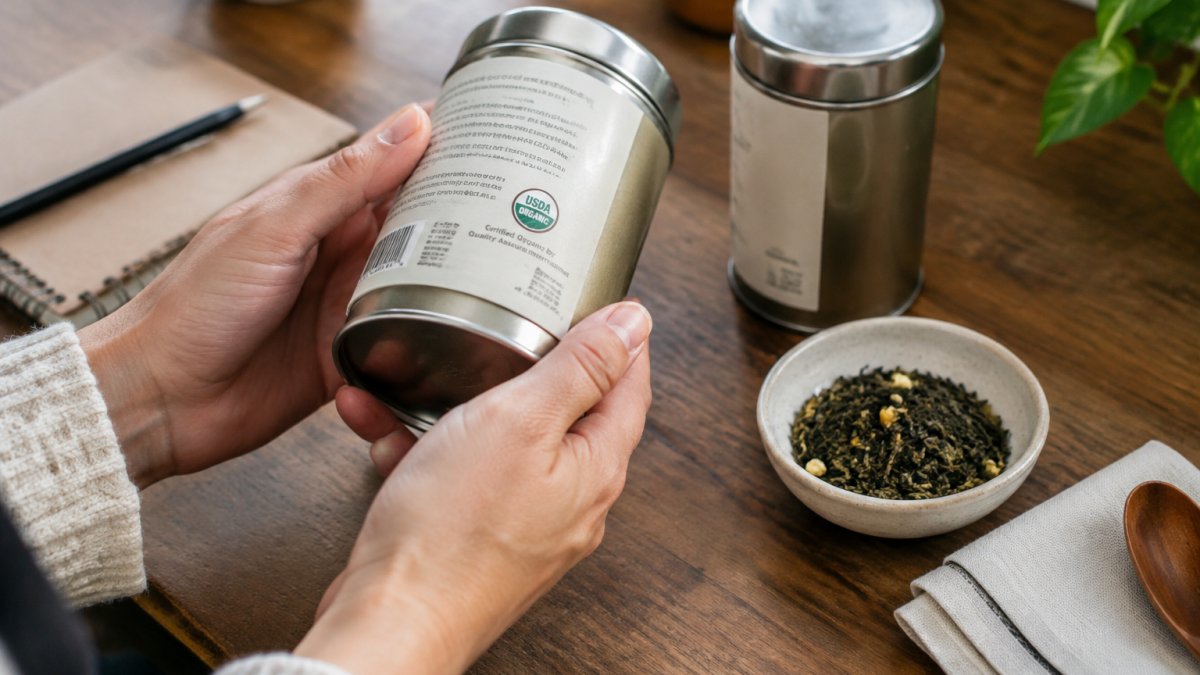
Work through these checks in order:
- Find the certifier. Look for a named certifying agent on the back or side panel, not just the seal graphic.
- Check the certifier's status. Confirm the agent appears on the USDA's published list of accredited certifying agents.
- Match the handler to the product. The certificate should cover the company that blended or packed the tea, not only the farm.
- Ask for the certificate. Reputable sellers will supply a current organic certificate on request.
- Confirm the operation scope. A certificate for a farm does not automatically cover a separate blending facility.
Spotting a Fake Seal and Checking the Certifier
A counterfeit seal is usually a documentation problem, not a printing problem. If the back panel is silent about who certified the product, treat it as unverified.
The reliable move is to check the certifier's name against the official accreditation list.
Watch out: a seller who can produce a certificate for the farm but not for the facility where the tea was blended or repacked has only answered half the question, and the half they answered may not be the half that touches your cup. Maintaining the integrity of the supply chain requires diligence in verifying farm certifications to ensure that every stage of production remains compliant with established organic standards.
Verification takes about two minutes and follows a fixed order of checks.
| Step | What to do | What to look for |
|---|---|---|
| 1 | Find the certifier | A named certifying agent on the back or side panel |
| 2 | Check the certifier's status | The agent on the USDA's published accreditation list |
| 3 | Match the handler to the product | A certificate covering the blender or packer, not only the farm |
| 4 | Ask for the certificate | A current organic certificate supplied on request |
| 5 | Confirm the operation scope | Coverage of the separate blending facility |
Organic vs Natural: Why the Labels Are Not the Same
"Natural" is a marketing word with no certification behind it, while "organic" is a defined production standard with inspections attached. That single difference explains most of the confusion in the tea aisle.
The Federal Trade Commission's guidance on environmental marketing claims sets expectations for how advertising claims are substantiated, and it is a useful reminder that a word appearing on packaging is not the same as a word appearing in a regulation. "Natural" tells you something about how a company wants to be perceived. "Organic" tells you what an inspector verified.
Only the certified organic claim carries a third-party verification trail.
The Benefits of Organic Loose Leaf Tea for Daily Drinkers
For anyone drinking several cups a day, loose leaf tea offers a practical format choice, with whole leaves steeping in the water you drink.
Whole leaves unfurl in the water and can be steeped more than once. For readers weighing the two formats, our comparison of loose leaf tea versus tea bags covers how leaf size and brewing affect what ends up in your cup.
If digestion is part of why you drink tea, our guide to whether organic tea is better for digestion looks at polyphenols, caffeine-free herbs, and pesticide-free leaves in more detail.
International Equivalence Agreements and Supply Chain Traceability
Tea crosses borders before it reaches a shelf, and the organic claim has to survive that trip. International equivalence arrangements allow organic products certified under one country's system to be recognized under another's, which keeps a Japanese green tea or an Indian black tea from needing duplicate certifications at every border.
Organic products certified under a recognized foreign system can be sold in the US, provided the importer holds documentation connecting the finished package back to the certified source.
Traceability is the part shoppers underestimate. Each link in the chain holds records that connect a finished tin back to a certified source.
The USDA Agricultural Marketing Service's organic program resources explain how certification and trade recognition are administered. For a shopper, the practical takeaway is that a traceable supply chain is a documented one, and a seller who can name the certifier and the origin is a seller who can answer follow-up questions. A seller who can name only the origin, or only the seal, has given you a marketing answer rather than a records answer.
Watch out: a certificate that covers the farm does not automatically cover the importer or the repacker, so a tea can be grown organically and still lose its organic integrity somewhere between the port and the tin.
Choosing an Organic Tea You Can Actually Trace
Start with the origin, because a named growing region is easier to verify than a vague one. A single-origin tea gives you a specific place to ask about, and a specific place is something a certifier can inspect.
Our Sencha Kagoshima comes from a defined growing region, which makes it a straightforward starting point if you want a green tea whose source you can actually name. For readers still deciding which teas deserve a permanent spot in the rotation, our guide to the healthiest tea to drink daily compares green, black, and herbal options by caffeine level and benefit.
Our own selection runs to more than 120 organic loose leaf teas sourced directly from estate gardens, all USDA certified organic and hand-blended with natural flavor essences and pure essential oils rather than artificial ingredients. If you want the deeper comparison first, our breakdown of organic versus non-organic tea health risks covers pesticide residue, heavy metals, and what the organic standard does and does not address.
Frequently Asked Questions
What are the different levels of USDA organic labeling?
Organic labeling depends on the share of organic ingredients in a product. Products made entirely with organic ingredients can carry the USDA seal and say "100% organic," while lower shares are labeled differently. Check the package panel for the exact wording used.
Can you trust the organic label on tea?
You can trust it more than an unverified claim, because organic certification involves inspection by an accredited certifier. That said, the seal confirms a process was followed, not that a product is perfect. Check that the certifier name appears on the package, and treat a seal with no certifier named as a warning sign.
What is the difference between organic and certified organic tea?
Organic describes a farming approach; certified organic means a third-party certifier has verified that approach against USDA organic standards for tea. A grower can farm without synthetic pesticides and still not be certified. Only the certified version carries an annual inspection, a documented supply chain, and the legal right to display the USDA organic seal. When a package says organic but shows no certifier, you are relying on the brand's word alone.
Do organic tea labels guarantee the absence of all pesticides?
No. Certification restricts synthetic pesticides and fertilizers on the farm, but it does not certify a zero-residue result. What the label does give you is a documented standard and a certifier accountable for compliance.
Why do some organic teas carry additional certifications like Fair Trade?
USDA organic covers how tea is grown, not how workers are treated or paid. Fair Trade and Rainforest Alliance certifications address the social and environmental side: fair pricing for farmers, safe working conditions, and biodiversity protections. A tea carrying both the USDA seal and a Fair Trade mark has been checked on two separate fronts. If ethical sourcing matters to you, look for that second mark alongside organic tea certification.
Reading a tea label well is a skill, and it rewards the shopper who slows down for two minutes at the shelf. At Octavia Tea, we publish the certification behind every blend and source directly from estate gardens, so the claim on the tin is one you can check. Browse our organic loose leaf collection, and start with a tin you can trace from garden to cup.


Octavia Tea Sign In
Create New Account