























How to Test Imported Tea for Heavy Metals

Last Updated: November 16, 2026
Quick Summary
Heavy metal testing in imported tea means sending a representative composite sample of a defined lot to an accredited laboratory that tests dried leaf for lead, arsenic, cadmium, and mercury. You then read the certificate of analysis field by field, checking sample ID, method, units, reporting limits, and whether results are on dry leaf or brewed infusion.
- Define one lot as one garden, one harvest, and one processing run before sampling.
- Pull increments from several points, mix them into a composite, and keep a sealed reference portion.
- Confirm the lab's accreditation scope covers metals in dried botanical matrices, not just water.
- A COA reporting only heavy metals as one line does not give you per-metal results.
- Organic certification covers farming methods, not soil metal content or finished leaf levels.
Table of Contents
- Why Heavy Metal Testing in Imported Tea Matters
- The Metals Labs Look For: Lead, Arsenic, Cadmium, and Mercury
- Step 1: Take a Representative Sample Before You Ship
- Step 2: Choose and Verify an Accredited Laboratory
- Step 3: Read the Tea Certificate of Analysis Like a Buyer
- Lead in Tea: What the Result Actually Tells You
- Arsenic in Tea: Organic Doesn't Mean Metal-Free
- Organic Tea Safety: What Certification Covers and What It Doesn't
- Frequently Asked Questions
Why Heavy Metal Testing in Imported Tea Matters
Heavy metal testing in imported tea is the lab work that tells you whether lead, arsenic, cadmium, or mercury shows up in a shipment, and at what levels. A beautiful leaf tells you nothing about what the plant pulled from its soil.
Here is the uncomfortable part most buyers learn late: a tea can be certified organic and still carry measurable metals. Certification governs how a garden is farmed. It does not measure the soil the bushes grow in.
Below, we walk through where contamination starts, which metals matter, and how to test a shipment yourself, step by step, from sampling to reading the report.
Where Contamination Comes From: Soil, Roots, and Processing
The tea plant is a accumulator. It draws metals from soil through its roots and holds them in the leaf, and older leaves hold more than young buds.
Three pathways do most of the damage:
- Soil and geology. Some growing regions sit on rock naturally rich in metals.
- Water and inputs. Irrigation water and some fertilizers can add metals over years.
- Processing and storage. Contact with metal surfaces, dust, and poor storage adds risk after harvest.
The practical takeaway: origin matters, but so does the specific garden and its soil history.
The Metals Labs Look For: Lead, Arsenic, Cadmium, and Mercury
Four metals dominate a standard tea panel: lead (Pb), cadmium (Cd), arsenic (As), and mercury (Hg). Labs sometimes add chromium (Cr) and other trace elements.
Lead in tea is the one buyers ask about most. It can arrive from soil, from atmospheric dust, and from older processing equipment. Arsenic in tea deserves its own attention because it comes in different chemical forms, and the form changes the risk.
Cadmium tends to build up in the plant over time. Mercury is less common in tea but appears in broad screening panels.
A lab reports each metal separately. One clean number does not clear the others.
Step 1: Take a Representative Sample Before You Ship
The single biggest mistake in heavy metal testing is testing the wrong sample. A lab can only measure what you send.
Tea is not uniform. Leaves from the top of a sack differ from the bottom. A single scoop proves nothing about the lot.
Follow this sampling sequence:
- Define the lot. One lot means one garden, one harvest, one processing run.
- Take increments, not one scoop. Pull small amounts from several points in the sack or chest.
- Mix the increments. Combine them into one composite sample.
- Split the composite. Send one portion to the lab and keep one sealed for reference.
- Label everything. Lot number, garden, harvest date, and sample date.
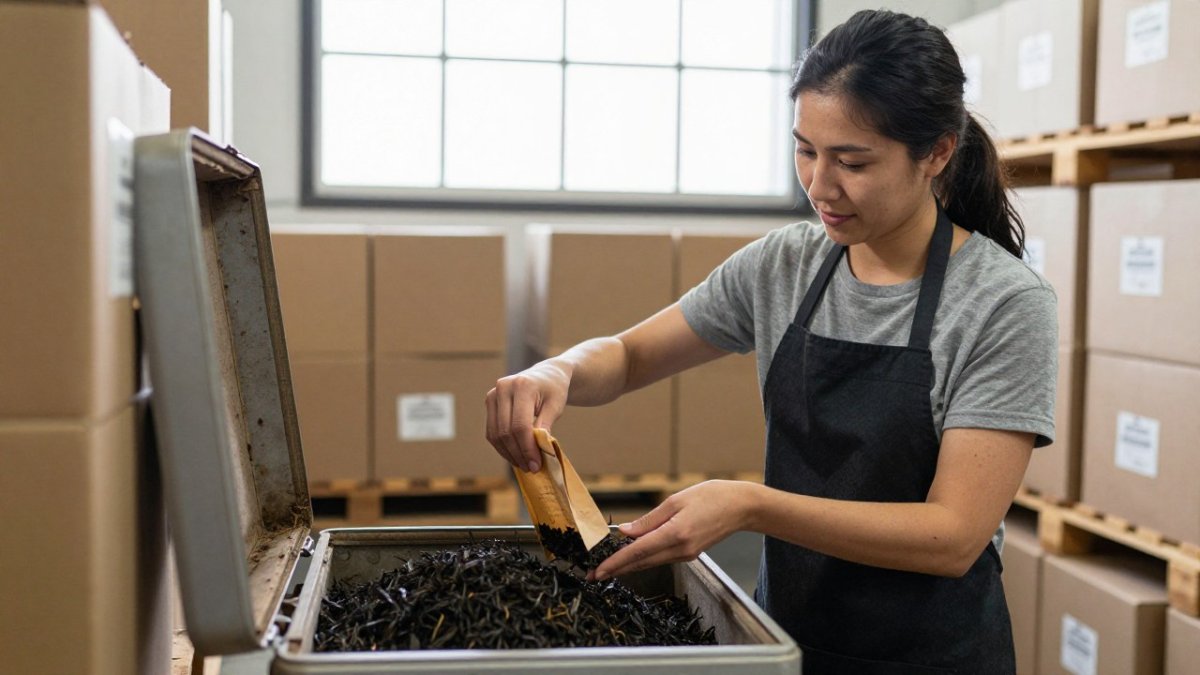
If you want to see what traceable provenance looks like on a single-garden tea, our Himalayan Imperial Black comes from one small garden, which makes lot-level sampling far simpler.
The woman is American.
Step 2: Choose and Verify an Accredited Laboratory
An accredited lab is one whose methods and quality controls have been reviewed by an independent body against a recognized standard. Accreditation is the difference between a number you can defend to a buyer, an importer, or a regulator and a number you cannot. The mechanism is straightforward: an assessor reviews the lab's written procedures, watches its analysts run the method, checks its calibration and quality-control records, and confirms it participates in proficiency testing against other labs. That is why an accredited result carries weight a home kit or an in-house screen does not.
Verify these before you send anything:
- Scope of accreditation. Confirm the specific metals and matrices are covered, not just the lab overall. A lab can be accredited for water and not for dried botanical matrices.
- Method reference. Ask which analytical method they use for each metal. Inductively coupled plasma mass spectrometry (ICP-MS) is common for trace metals because it reaches very low detection limits; inductively coupled plasma optical emission spectrometry (ICP-OES) is also used but typically reports higher limits. Graphite furnace atomic absorption is another option for lead and cadmium.
- Detection limits. Confirm the reporting limits sit below the levels you care about. A method that cannot report below your target level is the wrong method, no matter how accredited the lab.
- Sample preparation. Ask whether they digest the leaf whole or run a leachate, and whether they report on a dry-weight basis. Preparation drives the number as much as the instrument does.
- Turnaround and sample size. Confirm how much tea they need and how long results take. Rush turnaround usually costs more and can compress quality-control steps.
- Proficiency testing. Ask whether the lab participates in external round-robin testing for metals in botanical matrices and whether you can see the summary results.
Testing costs vary by panel size, method, and turnaround, so ask the lab for a written quote.
What Accreditation Actually Means
Accreditation means an outside assessor has checked the lab's competence for defined tests. It is not a guarantee of accuracy on every sample, but it is the minimum bar. The scope document is the part that matters: it names the analytes, the matrices, and the methods the lab has actually been assessed on. Read it, and match it to your tea.
Watch out: a lab that is accredited for environmental water samples is not automatically qualified for dried tea leaf. The matrix is different, the digestion is different, and the reporting basis is different.
For sourcing standards behind those claims, our guide to organic wellness tea quality and sourcing covers how supply chains get verified.
Step 3: Read the Tea Certificate of Analysis Like a Buyer
A tea certificate of analysis (COA) is the document that reports what the lab found in your sample.
Start with sample identity.
Then read the analyte names.
Next, read the units and the basis.
Then read the reporting limit for each analyte. The reporting limit is the lowest concentration the method can reliably quantify.
Finally, look for the pass/fail criteria. A COA may compare each result against a specification the buyer and supplier agreed on, or against a regulatory limit.
Check these fields first:
| Field | What to Look For |
|---|---|
| Sample ID | Matches your lot and sample label |
| Sample description | Names lot, garden, and harvest date |
| Method | Named analytical method per metal |
| Result | Value with units, per metal |
| Reporting limit | Sits below your target level |
| Basis | Dry leaf or brewed infusion, stated clearly |
| Criterion | Specification or limit the result is compared against |
| Test date | Recent enough to represent the lot |
Watch out: a COA with no sample ID, no method, and no units is a marketing sheet, not a lab report.
For a side-by-side look at how brands present purity and supply-chain detail, see our premium organic tea brand comparison.
Dry Leaf vs. Brewed Infusion: Two Different Numbers
This distinction changes everything. A metal level in dry leaf is not the same as the amount that reaches your cup.
What matters for exposure is metal transfer during brewing: how much of the leaf's metal content moves into the infusion. Steeping time, water temperature, and leaf age all shift that transfer. A longer steep and hotter water generally move more into the cup, and older leaf tends to hold more metal to begin with.
A dry-leaf result tells you about the leaf. An infusion result tells you about the drink. Ask which one the COA reports, and if you are building an exposure estimate, ask the lab whether they can run an infusion preparation alongside the leaf.
Lead in Tea: What the Result Actually Tells You
A lead result tells you the concentration in that sample, on that basis, by that method. It does not tell you a health outcome on its own.
To turn a number into meaning, you need three things:
- The concentration and its units
- The basis, dry leaf or infusion
- Your exposure estimate, built from how much tea a person actually drinks
That last piece is where consumer risk assessment lives. Regulators set regulatory limits by working backward from daily intake, not from a single leaf reading.
Arsenic in Tea: Organic Doesn't Mean Metal-Free
Organic certification restricts synthetic pesticides. It says nothing about arsenic in soil, and the tea plant can take up arsenic regardless of farming method.
This is the gap that trips up health-conscious buyers. A USDA organic seal is a real and valuable claim. It is simply not a metals claim.
Ask for the COA alongside the certificate. The two documents answer different questions.
Organic Tea Safety: What Certification Covers and What It Doesn't
Organic tea safety rests on two separate pillars: how the tea was farmed, and what the finished leaf actually contains. Certification covers the first. Testing covers the second.
What organic certification covers:
- Prohibited synthetic pesticides and fertilizers
- Record-keeping and inspection of growing and handling
- Separation from non-organic product in the supply chain
What it does not cover:
- Soil metal content
- Metal levels in the finished leaf
- Metal transfer into the brew
For the evidence on how organic farming affects residues and runoff, our analysis of organic tea and the environment lays out what the research supports. And for the broader health-risk comparison, see organic vs. non-organic tea health risks.
Heavy metal testing in imported tea is not a box you tick once. It is a sampling discipline, a lab you have verified, and a COA you can actually read. Our catalog runs to more than 120 organic loose leaf teas sourced direct from estate gardens, hand-blended with natural flavor essences and pure essential oils, with no artificial ingredients. Wholesale partners get low minimums, and retail orders over $65 ship free.
Frequently Asked Questions
Which teas contain heavy metals?
Any tea can carry trace metals because the plant takes them up from soil, and older leaves and darker styles such as dark tea and oolong tend to hold more than young green or white leaves. Herbal teas are a separate case because they blend different plant parts. The level, not the presence, is what matters, so ask for heavy metal testing results on the specific lot rather than a general claim about the type.
What does 'heavy metal tested' mean on a tea label?
It usually means a laboratory ran a test on a sample and reported results for metals such as lead, arsenic, cadmium, and mercury. The phrase alone says nothing about which lab, which sample, or what the numbers were. Ask for the tea certificate of analysis behind the claim so you can see the method, the detection limit, and whether the sample was dry leaf or brewed infusion.
Does brewing tea reduce heavy metals in the cup?
Steeping transfers only a share of the metals present in the dry leaf into the infusion, and that share varies by metal, leaf style, water temperature, and steep time. A dry-leaf result therefore overstates what you actually drink. When you review lead in tea or arsenic in tea data, check whether the lab tested the brewed infusion, since that number is the one tied to daily intake and exposure estimates.
Are organic teas tested for heavy metals?
Organic certification addresses farming practices such as prohibited pesticides and synthetic fertilizers, not metal content in the finished leaf. Organic tea safety still depends on the soil and the processing chain, so a USDA organic seal and a current certificate of analysis answer different questions. Ask suppliers for both, and confirm the COA matches the lot you are buying.


Octavia Tea Sign In
Create New Account